 SWRainAlert
Enforcement
You Got a Notice of Violation from Georgia EPD. Now What?
The letter is not the penalty. It is a request for your version of events — and on a construction site, your version of events is almost entirely the rainfall record and the inspections that followed it.
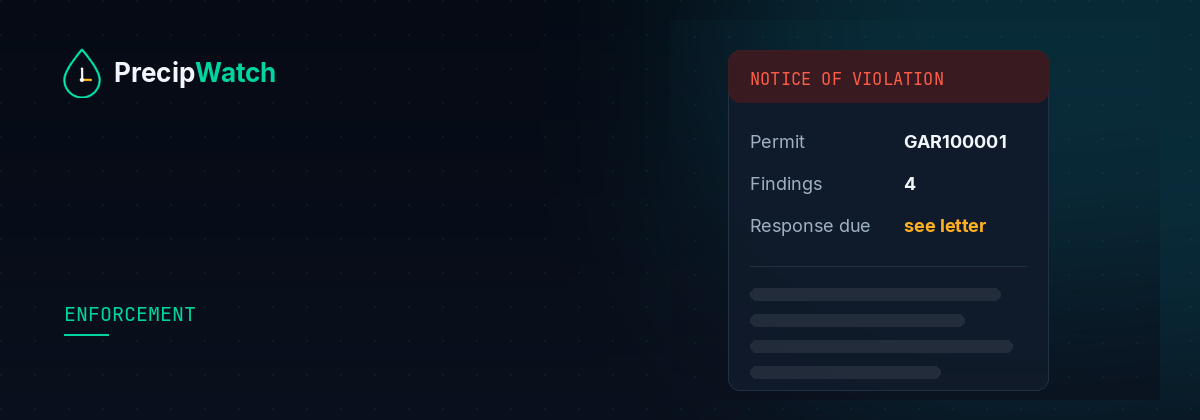
A notice of violation from the Georgia Environmental Protection Division arrives as a PDF attached to an email, and it is generally short. It names the site, names the permit, lists what the inspector believes they found, and asks you to respond by a date. The tone is administrative. The consequences are not necessarily.
The most common mistake is treating it as either a formality or a catastrophe. It is neither. It is a stage in a process, and the thing that most influences what happens next is the quality of what you send back.
What the letter actually is
EPD’s Watershed Protection Branch administers Georgia’s NPDES construction stormwater program. When an inspection or a complaint produces findings, the normal first step is to put those findings in writing and give the permittee an opportunity to respond and to correct.
That opportunity is the important part. An NOV is closer to a formal question: here is what we observed, tell us what you did and what you are going to do. Where it goes from there depends heavily on whether the response demonstrates a program that was being run, with genuine exceptions — or confirms that nobody was tracking anything.
We are not going to tell you how long you have to respond. The deadline is on your letter, it varies with the findings, and an article confidently stating “you have 30 days” is exactly the kind of stale authority that gets people into trouble. Read the date on the document. If it is tight, say so to EPD in writing early rather than missing it quietly.
The first 48 hours
- Stop the ongoing condition, if there is one. A finding that describes a live discharge or a failed control is materially different once it is fixed. Fix it, photograph it, and date the photographs.
- Freeze the records. Do not tidy the file, backfill the log, or re-sign anything. An amended record that looks amended is worse than a gap, and it converts an administrative problem into a credibility problem.
- Tell whoever needs to know. Georgia permits frequently involve a primary permittee and secondary permittees with separate obligations, and a response that contradicts another party’s records helps nobody.
- Pull the rainfall record for the whole period in question — not just the dates named in the letter.
That last one is the step people skip, and it is the one that determines whether the rest of the response is possible to write.
What they will ask for
- The current SWPPP, including amendments, and evidence it reflects the site as it actually is.
- The inspection reports for a stated period, with dates, the inspector’s name, and their GSWCC certification number.
- Evidence that inspections happened at the required frequency — both the routine cycle and the rain-triggered ones.
- Rainfall data for the site over that period.
- Corrective actions: what was found, what was done, when it was completed.
Notice how much of that is records rather than site conditions. An inspector arriving today cannot see what the site looked like in June. They can only read what you wrote down in June.
The rainfall question, specifically
Almost every documentation finding reduces to one question asked repeatedly: for each qualifying storm, did an inspection happen inside the window? To answer it you need three things lined up per site: rainfall by date with a source you can name; which of those storms reached the threshold over the permit’s measurement window; and an inspection report tied to each of them, dated inside the window.
If you have all three, the response largely writes itself. If you have the first two, you can at least be precise about which storms were missed and why, which is a far better position than vagueness.
Retrospective rainfall data is genuinely available — NOAA’s archives support estimating what fell at a coordinate on a past date, and Stage IV in particular is the quality-controlled record rather than a real-time estimate. What it cannot do is manufacture an inspection.
A caution about reconstructing. Producing rainfall figures now, for storms months ago, and presenting them as though they were what you relied on at the time is not a reconstruction — it is a misrepresentation. Say plainly that retrospective data is retrospective, and say where it came from. Regulators are considerably more tolerant of “here is what we can now establish” than of a record that quietly implies knowledge nobody had.
The GAR100001 clock is stranger than it looks
Georgia’s current stand-alone construction permit took effect on 1 August 2023 and runs to 31 July 2028. Part IV.D.4 requires inspections “within 24 hours of the end of a storm that is 0.5 inches rainfall or greater (unless such storm ends after 5:00 PM on any Friday or on any non-working Saturday, non-working Sunday or any non-working Federal holiday …). Post-rain inspections will reset the 7-day inspection frequency requirement.” Three things in that sentence produce findings.
The clock starts at the end of the storm
Not when the threshold is crossed. A storm that crosses 0.5″ at 14:00 and carries on raining until 23:00 has a deadline counted from 23:00. Logs that record the crossing time and count from there are computing a different, earlier deadline than the permit does.
The after-hours exception is narrow
After 5:00 PM on a Friday, or on a non-working weekend day or federal holiday. Not any evening, and not a Saturday the crew is working. People reach for this clause more often than it applies, and invoking it for a Tuesday night storm invites a second look at everything else in the file.
The post-rain inspection resets the seven-day cycle
Georgia separately requires a routine inspection at least once every seven calendar days — twice every seven for certain elevated-risk sites. Because a rain inspection resets that clock, a log tracking the two obligations in separate spreadsheets will routinely show gaps that are not real, and occasionally hide gaps that are.
Writing the response
Structure beats eloquence. Take each numbered finding in the agency’s own order and numbering, and answer it in its own section: what you found on checking, the evidence attached and labelled, what was corrected and when, and what has changed procedurally so it does not recur.
Disagreeing is legitimate where you have grounds. Do it on facts and dates, not on tone. “The inspection on 14 June was performed within the window; the report is attached as Exhibit C” is an argument. “We take compliance extremely seriously” is not, and every regulator has read it several thousand times.
What changes afterwards
Sites that have been through this once stop relying on somebody noticing the weather, because “nobody realised that storm qualified” is the root cause behind most documentation gaps and it is entirely preventable.
They stop keeping rainfall in one place and inspections in another, because that pairing is the thing a regulator asks you to demonstrate. And they start keeping the source: “0.62 inches” in a spreadsheet cell is an assertion, while “0.62 inches, NOAA MRMS, with Stage IV reporting 0.47 inches for the same period” is a record.
Common questions
Is a notice of violation the same as a fine?
No. A notice of violation states what the agency believes it found and asks you to respond. It is a stage in a process, not the end of one. What you send back materially affects where the process goes next, which is why the response is worth taking seriously even when the findings look minor.
What rainfall record does Georgia EPD expect?
GAR100001 requires inspection by certified personnel within 24 hours of the end of a storm of 0.5 inches or greater. To show compliance you need a per-site record of rainfall by date, which storms reached 0.5 inches in 24 hours, and an inspection report tied to each of those storms inside its window.
Can I reconstruct rainfall data after the fact?
Partly. NOAA archives support retrospective rainfall estimates for a location, and NOAA's Stage IV product in particular is the quality-controlled record. Retrospective data can establish which storms qualified, but it cannot create an inspection that was never performed. Label retrospective data as retrospective.
Does a post-storm inspection reset the seven-day clock in Georgia?
Yes. Under GAR100001, post-rain inspections reset the 7-day inspection frequency requirement. That interaction is a common source of apparent gaps in a log when the two obligations are tracked separately.
A note on what this is. General guidance, not legal advice. Your permit, your SWPPP and your state’s requirements govern, and they differ. SWRainAlert is a monitoring and recordkeeping aid, not a compliance guarantee — where a permit names an on-site rain gauge as the system of record, the gauge is the record.