 SWRainAlert
Permit language
“Qualifying Rain Event”: What Your Permit Actually Means
Two permits can use two different phrases for what looks like the same storm, and require two different things of you.
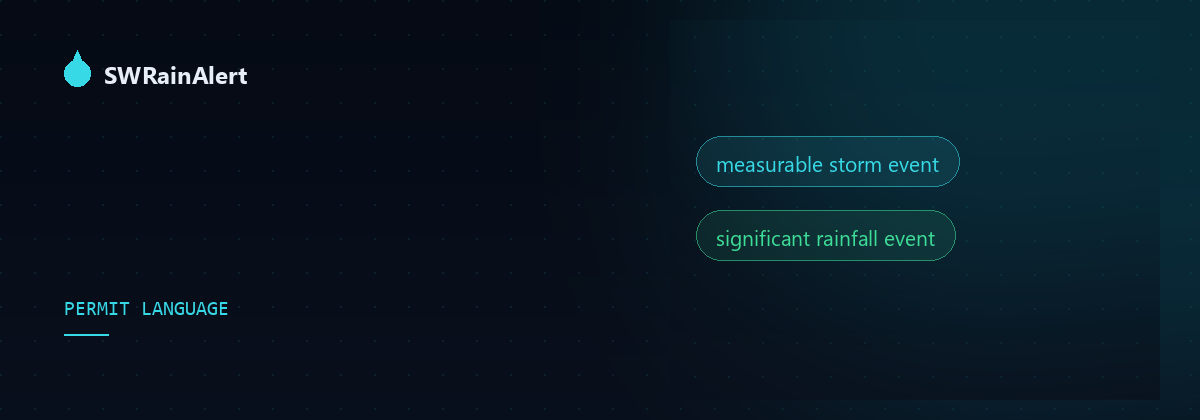
Permit drafting is not standardised across states, and the vocabulary around rainfall shows it. The phrase your permit uses is not decoration — it determines the trigger, the measurement, and what you owe afterwards.
Measurable storm event
The most common construction framing. A storm producing at least a stated depth — 0.25″ federally, 0.5″ in much of the southeast — measured over a 24-hour period. Crossing it starts an inspection obligation with its own response window, usually 24 hours.
The detail people miss is that “measurable” is doing real work in that phrase. It refers to a threshold depth, not to whether rain was observed. A trace of rain is not a measurable storm event, and treating every damp morning as a trigger produces a log nobody can use.
Significant rainfall event, and the rain log
South Carolina is the instructive case, and the one most often misrepresented. Under SCR100000 a storm of 0.5″ or more is a significant rainfall event that must be recorded in the site rain log and reported on the next weekly inspection report.
A post-storm site inspection is recommended. It is not required. The binding requirements are the rain log entry and the weekly inspection.
This one is worth knowing before you buy software. Several vendors market South Carolina as a post-storm inspection state, because it makes the product sound more necessary. Read SCR100000; it does not say that. We ship SC as a rain log workflow and label our verification of it as partial, because that is where our reading actually stands.
Why the distinctions matter operationally
| Framing | What the storm is | What you owe | When |
|---|---|---|---|
| Measurable storm event (GA, TX, FL) | A qualifying event | A site inspection | Within 24 h |
| Significant rainfall event (SC) | A rain log entry | Log it; report on the weekly | Next weekly report |
The same 0.6-inch storm, under two different permit framings
A team running sites in Georgia and South Carolina under one procedure is either over-inspecting in South Carolina or under-logging in Georgia. Neither is free.
Read the definitions first
Permits define their terms in a definitions section, and the inspection requirements then use those defined terms precisely. Reading the inspection section on its own is how people end up applying a threshold to the wrong kind of event. Two questions settle most of it:
- What exactly does my permit call the thing that triggers an obligation, and where is that phrase defined?
- Does crossing it require an inspection, a log entry, or preparation in advance?
Common questions
What is a qualifying rain event?
It is a permit-defined term, and the definition varies. In most construction general permits it means a storm producing at least a stated depth of rainfall, commonly 0.25 or 0.5 inches, measured over 24 hours, which triggers an inspection obligation.
Does South Carolina require an inspection after rain?
SCR100000 recommends a post-storm site inspection but does not require one. What it requires is that a rainfall event of 0.5 inches or more be recorded in the site rain log and reported on the next weekly inspection report.
A note on what this is. General guidance, not legal advice. Your permit, your SWPPP and your state’s requirements govern, and they differ. SWRainAlert is a monitoring and recordkeeping aid, not a compliance guarantee — where a permit names an on-site rain gauge as the system of record, the gauge is the record.