 SWRainAlert
Enforcement
What a Stormwater Violation Actually Costs
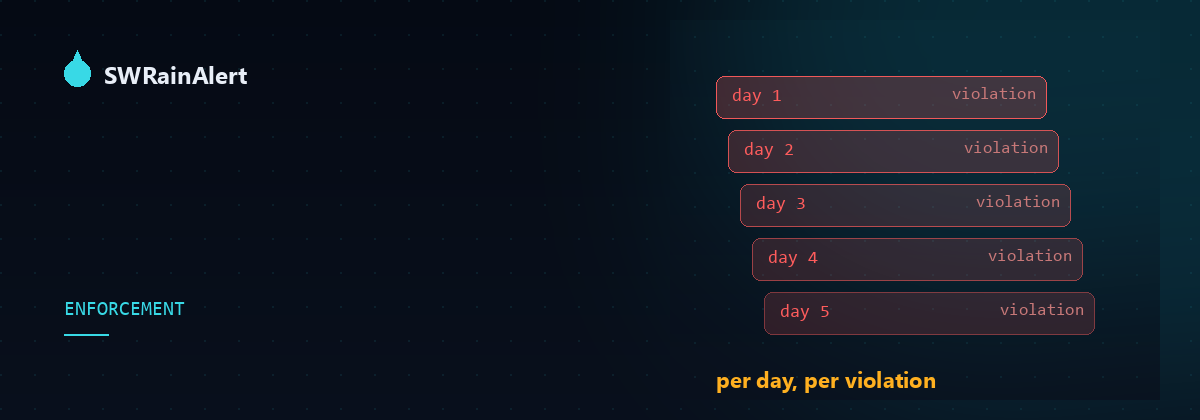
Penalties are assessed per day and per violation, which means the expensive part is rarely the discharge itself. It is the weeks of missing records behind it.
Most people in construction have a rough sense that stormwater violations are expensive. Fewer have a clear picture of how the number is built, which matters, because the structure of the penalty explains why recordkeeping failures cost more than they look like they should.
How the number is built
Construction stormwater discharges are regulated under the Clean Water Act through the NPDES permit program. Civil penalties for permit violations are authorised per day of violation, with statutory maximums set by the Act and adjusted annually for inflation under federal law. EPA publishes the current adjusted figures; state agencies operating delegated programs have their own authorities and their own maximums.
We are not going to quote you a dollar figure. The statutory maximums change every year with the inflation adjustment, and an article confidently stating last year’s number is exactly the kind of stale authority this industry has too much of. Check EPA’s current civil monetary penalty table, and your state agency’s, for the figures that apply today.
What is stable is the shape: the daily multiplier. A discharge that continued for three weeks is not one violation; it is potentially twenty-one. A required inspection that was never performed, on a site that operated for four months, is not one missed inspection — it is a pattern, and enforcement treats patterns differently from incidents.
What actually gets cited
In practice, the findings that appear most often in construction stormwater enforcement are not dramatic discharge events. They are administrative:
- Inspections not performed at the required frequency, or not after qualifying rain events.
- Inspection reports missing or incomplete — no date, no inspector name or certification, no rainfall amount, no description of what was observed.
- Corrective actions not documented, or documented as identified but with no record of completion.
- No rainfall data to establish whether an event-triggered inspection was required at all.
- SWPPP not updated to reflect site conditions as they actually changed.
Notice how many of those are records rather than practices. A crew can be doing the right thing on site and still be exposed, because the ability to demonstrate it later is a separate discipline from doing it.
The asymmetry worth internalising
An inspector arriving after the fact cannot observe what your site looked like three weeks ago. They can only read what you recorded. Which means, for enforcement purposes, an inspection that happened but was not documented is very close to an inspection that did not happen.
The reverse asymmetry is the useful one: complete, contemporaneous records are disproportionately valuable, because they are the only evidence that exists. A file showing that every qualifying storm was identified, every inspection was performed inside its window, and every corrective action was opened and closed with dates changes the conversation from “prove you complied” to “here is the record.”
Where monitoring fits
Rainfall monitoring does not prevent a discharge. What it removes is the most common root cause of a documentation gap: nobody knew the storm qualified. If the trigger is detected automatically, the deadline is computed in the site’s local time, and the inspection is filed against the event that caused it, the record assembles itself as a by-product of doing the work.
To be explicit about what this is: SWRainAlert is a monitoring and recordkeeping aid, not a compliance guarantee, and nothing here is legal advice. Where your permit names an on-site rain gauge as the system of record, the gauge is the record. Talk to your environmental counsel about your specific exposure.
Common questions
How much is the fine for a stormwater violation?
Clean Water Act civil penalties are assessed per day and per violation, with statutory maximums set in law and adjusted annually for inflation. Because those figures change every year, check EPA's current civil monetary penalty table and your state agency's own schedule rather than relying on a number quoted in an article.
What is the most common stormwater violation on construction sites?
Documentation failures: inspections not performed at the required frequency or after qualifying rain events, incomplete inspection reports, undocumented corrective actions, and no rainfall record establishing whether an event-triggered inspection was required.
Can good records reduce a penalty?
Records are the primary evidence of what you did and when. Complete, contemporaneous documentation showing that events were identified and inspections performed within their windows is materially different from a file with gaps in it. Specific outcomes depend on the agency and the facts, so take advice on your own situation.
A note on what this is. General guidance, not legal advice. Your permit, your SWPPP and your state’s requirements govern, and they differ. SWRainAlert is a monitoring and recordkeeping aid, not a compliance guarantee — where a permit names an on-site rain gauge as the system of record, the gauge is the record.